
A plain-English glossary of the words you will meet when you shop for a Persian, Afghan or Oriental rug, from abrash to Ziegler. Each term links to rugs or guides where it matters.
A–C
- Abrash
- Gentle bands of slightly different color in a handmade rug, caused by wool dyed in small batches. A sign of hand work and natural dyes, not a flaw.
- All-over design
- A pattern that repeats across the whole field with no central medallion.
- Antique rug
- A rug about 100 years old or more. See Vintage vs Antique Rugs.
- Area rug
- Any rug that covers part of a floor, as opposed to wall-to-wall carpet.
- Asymmetric knot
- Also called the Persian or Senneh knot: the yarn wraps fully around one warp and loosely around the next. Allows very fine, curving designs.
- Baluch
- Small, dark, richly patterned tribal rugs woven by Baluch families in Afghanistan, Iran and Pakistan.
- Bokhara
- A trade name for Turkmen rugs with rows of octagon guls, usually on red. Named after the old market city of Bukhara. Mauri and Bokhara rugs.
- Border
- The bands framing the field. Most rugs have a main border and thinner guard borders on each side.
- Chobi
- Afghan rugs in soft, muted colors from vegetable dyes, with open floral designs. Popular in modern rooms. Chobi rugs.
- Corrosion (oxidation)
- Lower pile in areas dyed dark brown or black, because the old dye wore the wool faster. Common and expected in antique rugs.
D–H
- Dhurrie
- A flat-woven cotton or wool rug from India.
- Dry rot
- Cotton foundation weakened by long dampness; the rug cracks when folded. Ask about it before buying an old rug.
- Field
- The main area of the rug inside the borders.
- Flatweave
- Any rug woven without pile, such as kilim, soumak and dhurrie.
- Fringe
- On a hand-knotted rug, the ends of the warp threads that run through the whole rug. Sewn-on fringe means the rug is not hand-knotted.
- Gabbeh
- Thick, loosely knotted tribal rugs with simple designs and large areas of plain color.
- Ghazni wool
- Handspun wool from sheep around Ghazni, Afghanistan, rich in lanolin and known for its soft sheen.
- Gul
- The octagon-shaped medallion repeated across Turkmen and Afghan rugs. Each tribe has its own gul.
- Hand-knotted
- A rug in which every knot is tied by hand. The strongest, longest-lasting construction. See Hand-Knotted vs Hand-Tufted vs Machine-Made.
- Hand-tufted
- Yarn punched through a canvas with a tool and held with glue. Lasts years, not generations.
- Heriz
- Bold, geometric Persian rugs from northwest Iran with large medallions, known for being tough.
K–O
- Kazak
- Bold, geometric rugs with thick wool, first woven in the Caucasus. Today many are woven in Afghanistan and Pakistan. Afghan Kazak rugs.
- Khal Mohammadi
- A fine Afghan Turkmen rug with deep red color and small guls, named after a weaver and his village.
- Kilim
- A flat-woven rug with no pile, its pattern made by the colored weft. See What Is a Kilim Rug? · Shop kilims.
- KPSI
- Knots per square inch. More knots allow finer detail. Village rugs often have 60–150 KPSI; fine city rugs can pass 300.
- Lanolin
- The natural oil in wool. It gives good wool its sheen and helps it resist dirt and stains.
- Madder
- A plant root that gives the classic red of Afghan and Persian rugs.
- Mauri
- Fine Turkmen rugs from western Afghanistan, often with rows of guls on rich red.
- Medallion
- A large central design in the field, often round or diamond-shaped.
- Nain
- Fine Persian city rugs, often ivory and blue, with silk outlining the design.
- Oriental rug
- The broad name for hand-knotted rugs from Iran, Afghanistan, Turkey, the Caucasus, India, Pakistan and China. See Afghan vs Persian Rugs.
- Overdyed rug
- An older rug washed out and dyed one strong color, such as blue or pink, for a modern look.
P–S
- Persian rug
- A hand-knotted rug woven in Iran. Persian rugs.
- Pile
- The cut yarn ends that form the rug's soft surface. Pile height ranges from low and flat to thick and plush.
- Rug pad
- A layer under the rug that stops slipping, protects the floor and the rug, and adds comfort. Rug pads cut to size.
- Runner
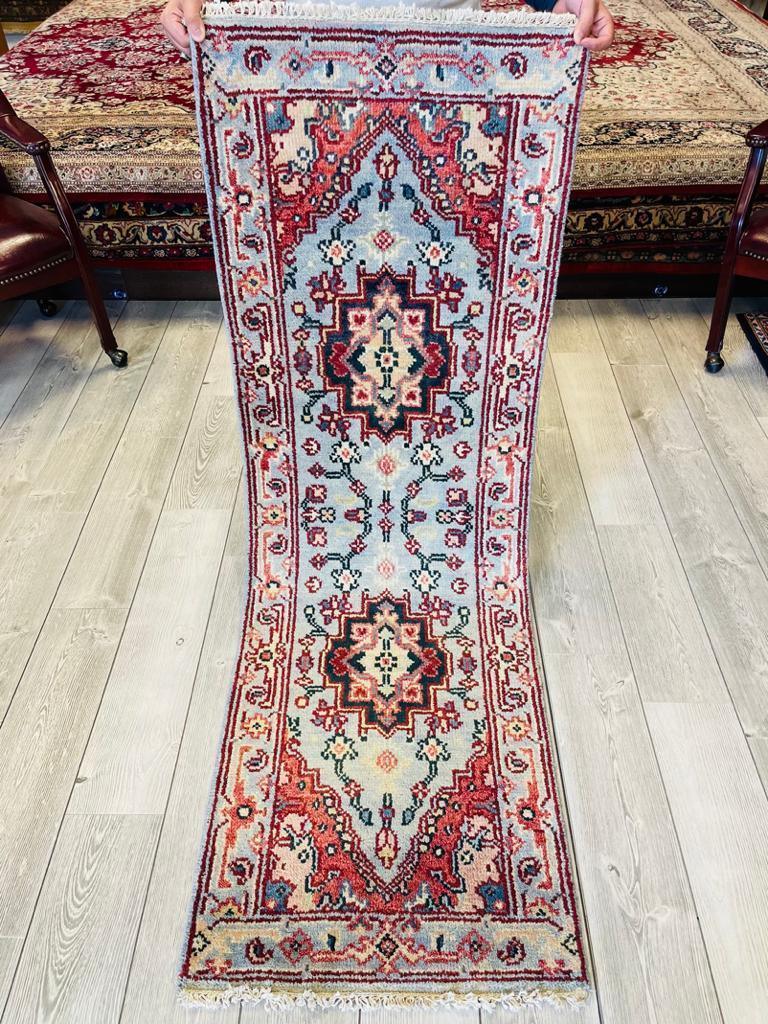
- A long, narrow rug for hallways, kitchens and stairs, often 2 to 3 feet wide. Runners.
- Selvedge
- The wrapped side edges of a rug that keep it from unraveling.
- Serapi
- Older Heriz-region rugs with open, geometric designs and soft colors, much sought after.
- Soumak
- A flatweave in which weft is wrapped around the warp, giving a fine herringbone-like surface.
- Symmetric knot
- Also called the Turkish or Ghiordes knot: the yarn wraps around two warps evenly. Strong and common in Kazak and village rugs.
T–Z
- Tabriz
- Fine Persian city rugs from northwest Iran, famous for detailed floral and medallion designs.
- Tribal rug
- A rug woven by nomadic or village families from memory rather than a drawn plan, with bold geometric motifs.
- Vegetable dye
- Color from plants and minerals, such as madder, indigo and pomegranate. Ages softly and shows abrash.
- Vintage rug
- A rug about 20 to 99 years old. Vintage and antique rugs.
- Warp
- The threads running the length of the rug, on which the knots are tied. They end as the fringe.
- Weft
- The threads woven across the width, between rows of knots, to hold them in place.
- Ziegler
- A rug style from 1800s workshops in Sultanabad, Iran, run by Ziegler & Co., with large, open floral designs in soft colors. Many Afghan Chobi rugs revive it.
Have a word we did not cover, or a rug you want identified? Chat with us, or book a written rug appraisal.